
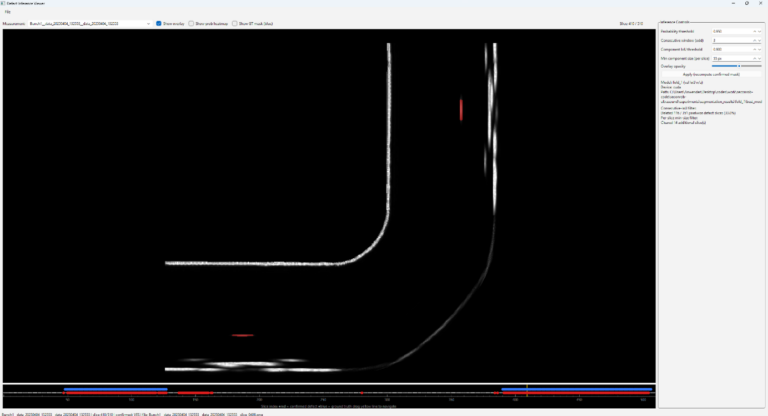
An important milestone in WP4 has been reached: For the defect classification and evaluation machine learning methods are used by Fraunhofer to separate defective from non-defective regions and to classify different defect types as required by subsequent process steps. A software which comprises a set of tools was designed to automatically detect, extract and classify defects from data collected by the Ultrasound testing process. Especially for ultrasound data, distinguishing artefacts caused by imaging of complex geometries from actual defects is necessary. The tools build on existing methods and refine them to meet the project’s objectives.
An end-to-end pipeline that converts raw .vlm ultrasound volumes into IoU-confirmed, statistically filtered defect components for downstream use, was implemented. All design choices are driven by the constraint that defects are ~10 px structures occupying under 0.1% of pixels in a textured background. The results show strong performance with IoU ≈ 0.831, Dice ≈ 0.908, high per-image recall (0.94–0.97), and negligible background false positives, with a post-processing 3-slice IoU check and a 55 px size filter removing ~28% of artefacts at minimal recall loss. The key contribution is defensibility and traceability: data-split handling at the measurement level, bootstrap-derived thresholds, explicit caveats, and fully reproducible scripts that allow rederivation of splits, retraining, and thresholding on future batches. A 0.2 pp recall reduction can yield substantial FP reductions (≈28%) and improved slice precision, while the recall cliff starts at T = 89 px, thus deployment below that value is essential.